Mike Kaye, co-founder and director, Sarah Kaye & Co. Buyers Agents
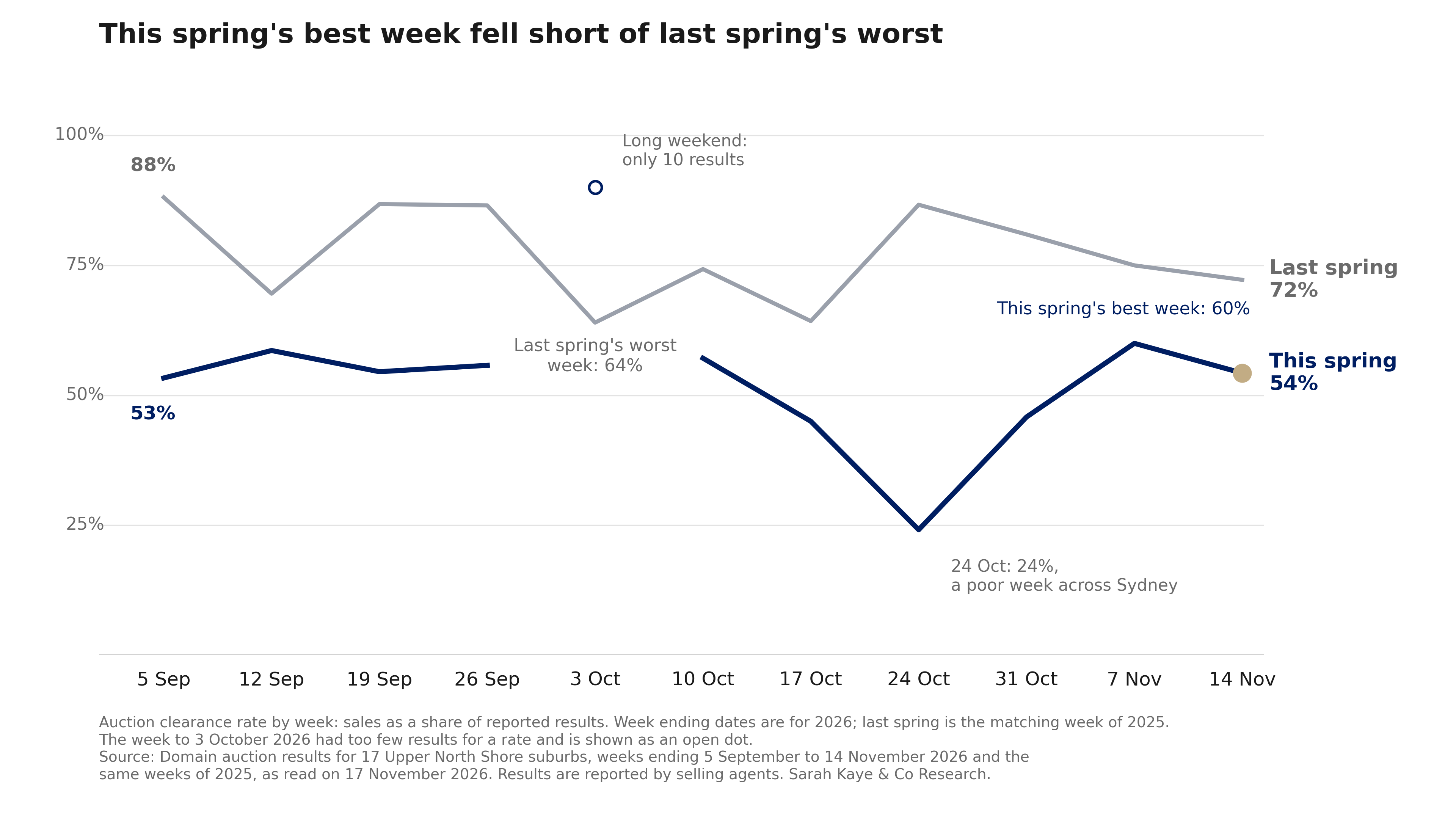
Last spring, a home taken to auction on the Upper North Shore almost always sold. This spring, about half did. What separated the two halves was the kind of home it was, and where it sat.
We counted every auction result published for 17 suburbs, from Roseville to Wahroonga and St Ives, over the 11 weeks to 14 November. Then we counted the same weeks last year. This is our last column for the year, so it does two jobs: it sums up spring, and it sets out what the numbers suggest for the new year.
Sales more than halved, and stayed there
Agents reported 162 auction sales this spring, a drop of 62% from last spring’s 425. The reported clearance rate also fell from 78% to 53%. It was not a slide. Spring opened at this level and held it.
What it means for you: If you are waiting for the season to pick up, it has had 11 weeks to do so. This is the market, not a bad patch.
Far fewer homes sold under the hammer
Only 52 homes sold under the hammer this spring, against 132 last spring. Properties withdrawn from an auction went the other way, from 34 to 98.
One thing did not change. In both springs, about two in three sales were agreed before auction day. The serious buyers still moved early. There were simply fewer of them, and many more owners withdrew before auction day.
What it means for you: An offer that arrives before auction day deserves real attention. This spring it was often the best one an owner saw.
What you own, and where, now decides the result
Apartments have cleared at 64%. Houses with five or more bedrooms (the home this area is known for) have cleared at 41%.
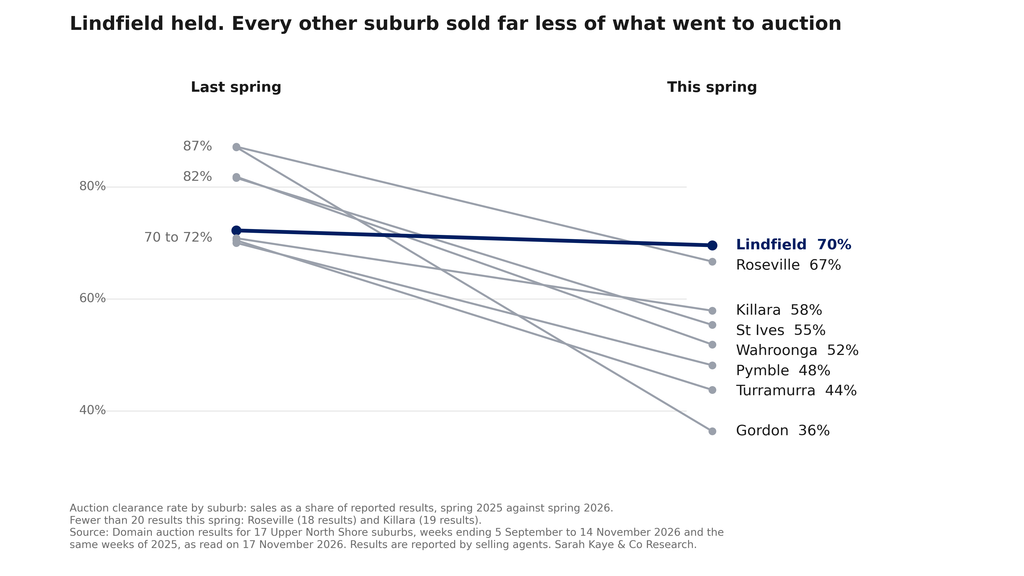
Place has mattered too. In Roseville, Lindfield and Killara, 65% of auction results were sales. In Pymble, Turramurra, Wahroonga and St Ives it was 50%. Apartments between Roseville and Killara sold about as readily as they did a year ago.
Put the two together and the gap is wide. A house in Wahroonga or Turramurra cleared at 46%. An apartment in Lindfield or Killara cleared at 83%.
Gordon was the exception. It sits in the middle of the line and is mostly apartments, yet only 8 of its 22 results were sales. A handful of apartment buildings were relisted week after week. Sometimes the building matters more than the suburb.
None of this showed last spring. Then, a house in St Ives and an apartment in Lindfield cleared at much the same rate. A strong market hides the differences; a weaker one reveals them.
Prices tell the same story. Cotality’s valuations show house values lower over the year to September in all 17 suburbs: by 10% to 22% in 10 of them, and by about 5% in Roseville and Lindfield, two of the most southerly Upper North Shore suburbs. The NSW Valuer General’s sales register, which runs some months behind, shows the fall began in April. Apartment prices largely held.
What it means for you: Suburb averages tell you less than they did a year ago. Compare your home with recent sales of the same type, in your own pocket, from the last few months. A sale in your street last spring is out of date.
A changed auction date rarely ended in a sale
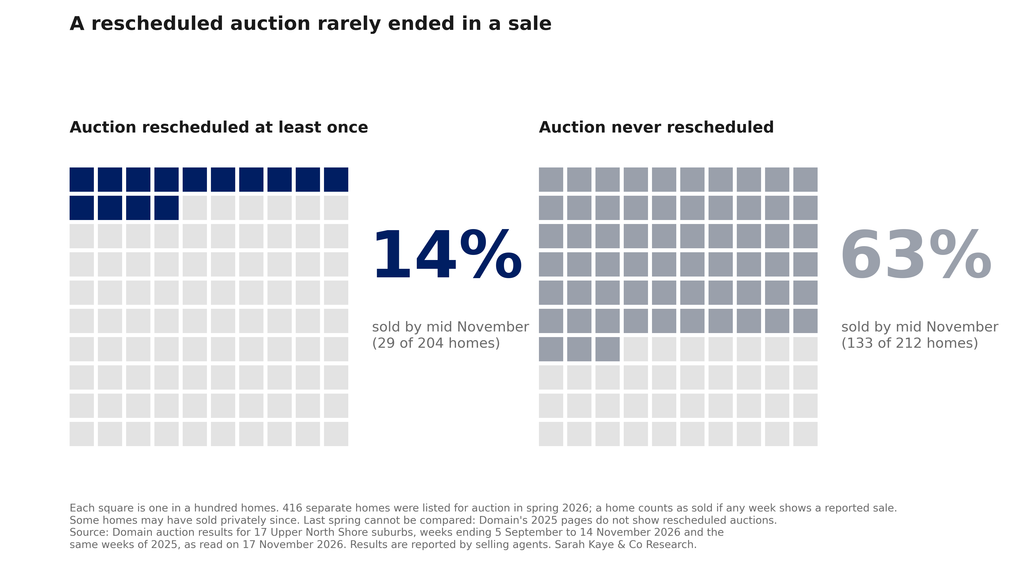
Of the 416 homes taken to auction this spring, 204 had the date moved at least once. By mid November, only 29 of those had a reported sale.
The homes that were never rescheduled sold at more than four times that rate. Moving the date did not find the buyer.
Nor was it a handful of homes. About 50% of all listed auctions were rescheduled (295 of 602), against about 25% across the rest of Sydney. St Ives had more auctions than any other suburb, most of them houses, and 71 of its 127 were rescheduled. If we count a rescheduled auction as a home that did not sell that week, then the Upper North Shore’s clearance rate was 27%, not 53%.
What it means for you: If a campaign is not producing offers, look at the price before you move the date.
The new year starts with a backlog, not a clean slate
Last November the Upper North Shore went into summer with most of its auction stock sold. This year, about 250 of those 416 homes (60%) had no reported sale by mid November. A few have sold quietly since.
Many listings will come back in the new year. They will be joined by the usual February listings. Buyers will have more to choose from, and more time to choose.
Nothing in 11 weeks of auction results this spring points to a turn in sales. Clearance was flat from September to November. Prices are a different matter. Cotality’s monthly valuations show the fall in house values slowing, from about 3% a month in July to about 1% in September.
What we see at inspections and appraisals each week says it has slowed further since. That may prove temporary. So the first months of the new year are likely to look much like spring for sales, with more homes on the market and steadier prices than in winter.
Three things would tell us it is changing; a clearance above 60% for several weeks in a row, fewer auctions rescheduled or withdrawn, and homes that come back in February at a lower price and sell.