
Mike Kaye, co-founder and director, Sarah Kaye & Co Buyers Agents
Most coverage of the Budget’s property tax changes has framed them as the dominant force shaping the Sydney property market. But it’s not the biggest factor pulling on Upper North Shore prices.
What the tax changes were supposed to achieve
The Treasurer’s own modelling framed the goal in surprisingly modest terms. Five property tax reforms – negative gearing abolished for new investors in established property, the 50% capital gains tax discount replaced with inflation indexation, a 30% minimum capital gains rate, pre-1985 assets brought into the tax net, and a 30% minimum tax rate on discretionary trust distributions — together are projected to deliver 75,000 additional first-home buyers over a decade. They are also projected to lift the home ownership rate from roughly 66% to 67%, and put $4.81 a week in additional take-home pay into a typical household’s pocket from July 2028.
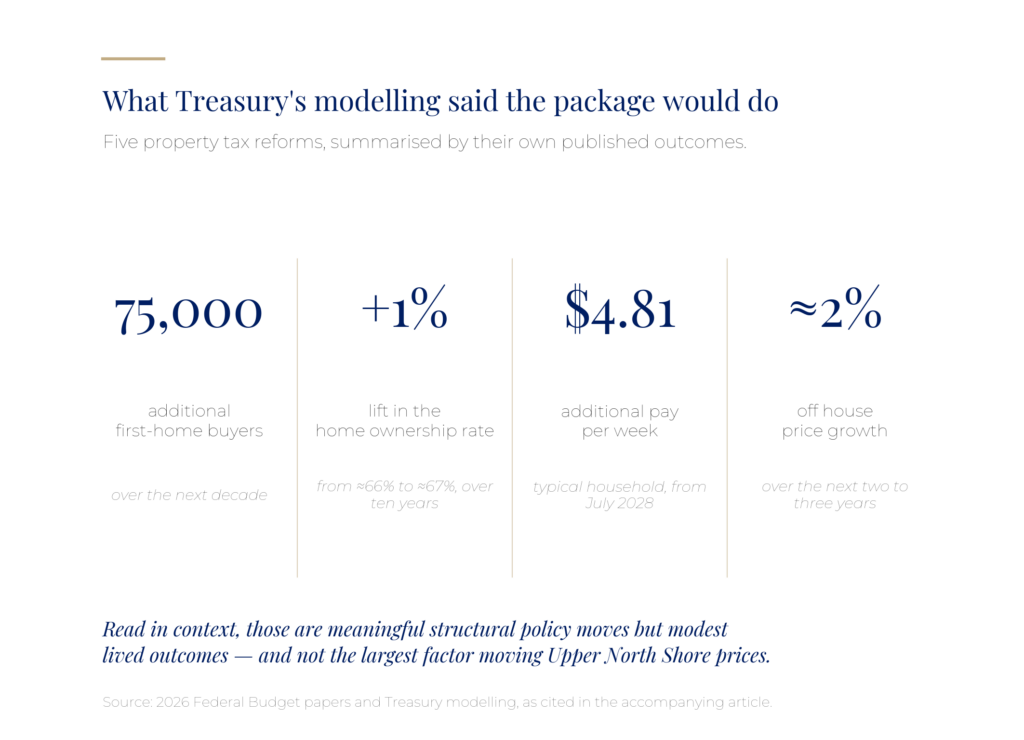
Read in context, those are meaningful structural policy moves but modest lived outcomes. A one-percentage-point lift in home ownership over 10 years. Less than $5 a week in additional pay, two years from now.
What the data has actually shown so far
It is too early to fully separate the impact of the tax changes from everything else that is happening in the property market such as the macroeconomic backdrop of a cash rate of 4.35%, inflation at 4.6%, the Iran war and high construction costs.
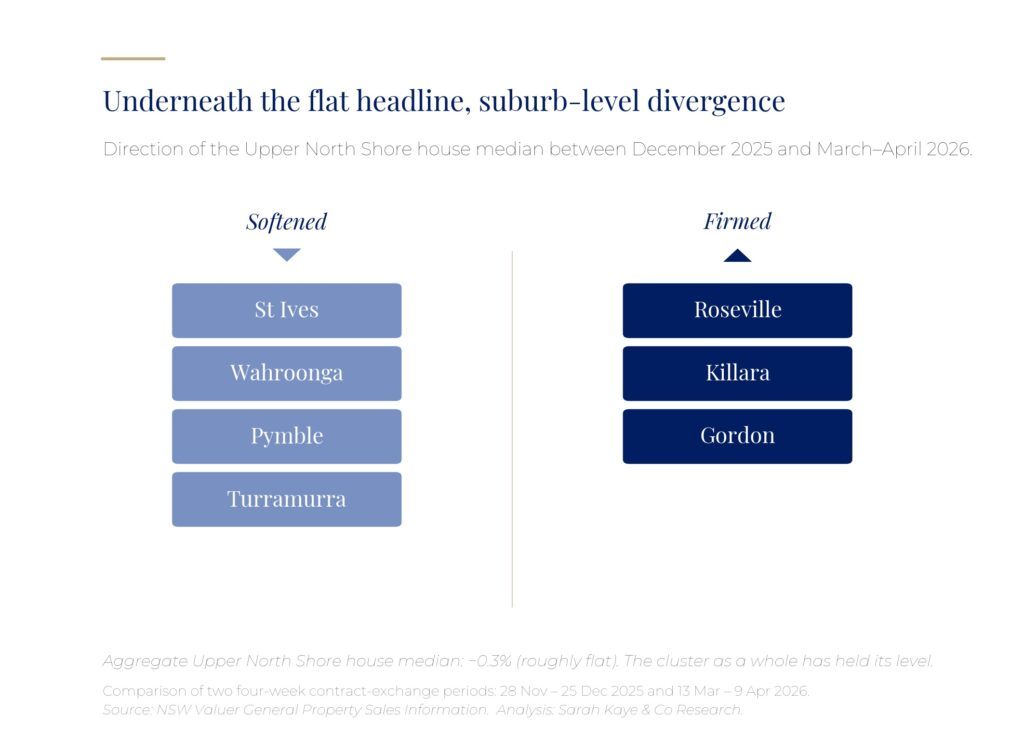
Analysis of the NSW Valuer General’s settled-sales data comparing two four-week windows of sales activity across the Upper North Shore, the four weeks before Christmas 2025 against the most recent four weeks (mid-May 2026), shows houses came in roughly flat, with a median change of -0.3%.
Underneath the flat headline, there is genuine divergence between suburbs. St Ives, Wahroonga, Pymble and Turramurra all softened. Roseville, Killara and Gordon firmed. The cluster as a whole held its level.
Units have been different. The aggregate Upper North Shore unit median fell by close to 20% between the two periods. Some of that is genuine softening at the higher end of the unit market – Pymble units fell 36% on the median. Some of it is a compositional effect. Hornsby’s unit volume nearly doubled over the same period at roughly stable prices, which is the signature of first-home buyers and downsizers absorbing more affordable stock.
Either way, the divergence between a flat house market and a softening aggregate unit market is the most interesting movement right now.
One widely quoted signal to set aside is the headline that Sydney’s preliminary auction clearance rate fell six percentage points in the week after the Budget.
The softening of the auction market has been happening for months, not since Budget night. The Budget may have accelerated it, not caused it.
Increasingly, properties that selling agents place on auction campaigns are being settled before auction day – sold prior, withdrawn, or quietly rolled into a private treaty conversation. The lower public auction volumes are partly a consequence of that shift in agent behaviour, not only of buyer reticence.
At inspections we are seeing fewer people through yet there are still serious buyers in the Upper North Shore market. They are simply being more rigorous. The composition of who is in the market has shifted, not the depth of activity.
What this means going forward
For existing Upper North Shore homeowners,
the direct tax impact on your own home is approximately zero. The principal-residence capital gains exemption was untouched. The indirect impact – slower price growth on a $3 million Wahroonga family home through to 2031 – works out to less than a single year of typical growth in our markets.
For future buyers in our suburbs, the tax architecture is genuinely in your favour. Less investor competition at auctions, slightly slower price growth, modestly higher borrowing capacity once the income-tax bracket changes land. The catch is that the macroeconomic setting – the rate at which you can borrow, the cost of any work you might want to do to a property after settlement – matters more for your actual purchase budget than the tax architecture does. Plan around the macro.
For existing investors already holding Upper
North Shore property, the negative gearing rules on those assets are grandfathered indefinitely. The new capital gains rules will apply when you sell, and on long-held property the inflation-indexation method with the 30% minimum floor usually costs more than the old 50% discount. The architecture is asking you to hold, not trade.
Anyone with investment property in a discretionary trust should be modelling the post-2028 distribution math with their accountant well before the rollover window opens in mid-2027.
For renters on the Upper North Shore, the Budget’s silence is the loudest thing in it. Slower investor activity over the next two to three years will mean a smaller pipeline of new rental supply, in a market where stock is structurally limited to begin with.